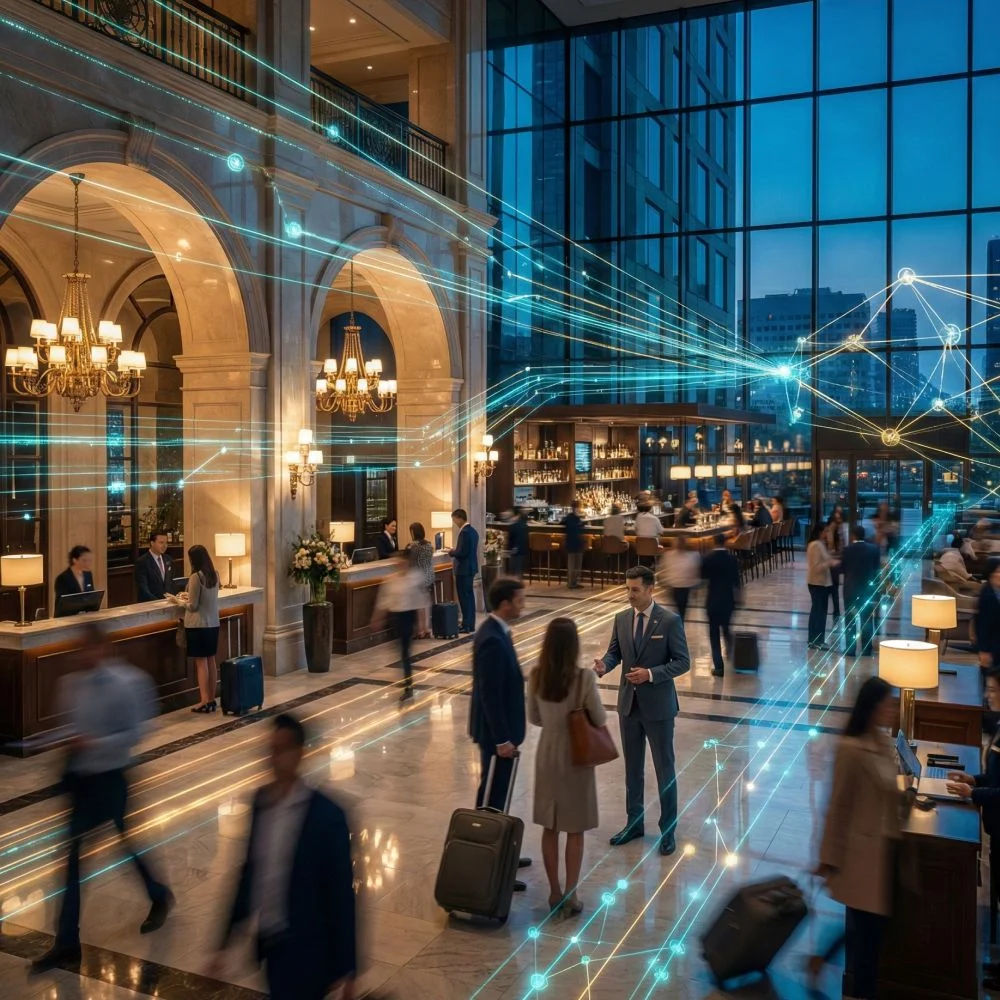
The global hospitality industry has more than bounced back from Covid. It’s entered a new era of sustained growth. Key to this is ERP technology.
Business owners have a choice: invest in integrated operational platforms or lose out to more agile, data-driven competitors. It’s not much of a choice, really. It’s kind of a no-brainer.
Modern ERP systems are designed to make life easier by managing guest services, financial management, and resource allocation, providing sound information on which to base financial and operational decisions.
Not sold?
Consider growth fuelled by new traveller demands and service expectations. Can your current system cope with a global market that expanded to $4.9 trillion in 2024? Hospitality accounts for 10% of global GDP. Is your system set up to grab a piece of that pie?
Disparity in Financial, Operational & Management Systems
The average hotel uses 8 – 12 separate systems. These data silos are catastrophic in the new tech-led era, with failures in legacy systems impacting guest loyalty and profits.
- Revenue Leakage: Your margins evaporate when staff can’t upsell services without real-time availability. Data locked in separate platforms can cost you lucrative cross-selling opportunities.
- Guest Experience Failures: Service breakdowns are inevitable without integration. For example, conflicting room status data leads to check-in delays. Non-integrated charges from various outlets result in billing disputes at checkout. Do this to sour a positive guest experience and lose repeat business.
- Staff Productivity Drains: Employees waste hours on manual data entry, reconciling conflicting information, and switching between systems. Hours that could be spent on high-value, guest-facing activities.
The Strategic Value of an Integrated ERP Ecosystem
Modern ERP platforms don’t like data silos. They’re too limiting and limited. Instead, flexible ERPs integrate and centralize front office (guest interactions, billing) and back-office (finance, inventory) operations to create a single source of truth.
Why is this important?
- It automates routine tasks and reduces human error.
- It streamlines workflows across multiple properties/locations.
- It improves inter-department communication, removing bottlenecks and delays.
- It enables real-time operational visibility and quick, informed decision-making.
Enhanced Financial Performance
The hospitality industry isn’t exactly known for its high margins. It’s important to maintain tight financial control with clear visibility into all processes and operations, like your supply chain.
One of ERP’s most important tasks is making sense of complex revenue streams. Take hotels, for example. Revenue comes from occupancy, hotel bars or restaurants, gift shops, and event hosting.
That’s a lot to manage, but that’s exactly what you have to do if you want to rein in costs and improve cost management.
Transforming the Guest Experience
Personalization is everything these days. But how do you keep every guest satisfied?
You use an ERP system, of course, and integrate a Customer Relationship Management (CRM) module. Specifically, CRM software designed for hotels and similar accommodation.
This gives you a 360-degree view of each guest, including preferences, history, and requests. This enables you to treat guests as individuals. It triggers loyalty and sets up repeat business and glowing reviews.
Dominant Technology Trends Reshaping Hospitality ERP
Clunky legacy systems are so five years ago. The day of agile, intelligent, and guest-centric operational models has dawned. Here are four tech trends to adopt if you want to succeed in the industry.
- Cloud-Based Platforms. They are more powerful, agile, accessible, secure, and cost-effective than traditional solutions.
- Artificial Intelligence (AI) and Data Analytics. The ability to analyze huge amounts of data provides insights that enable you to:
- Predict guest preferences
- Optimize pricing strategies
- Use predictive analytics for proactive forecasting and strategic planning.
- Best-of-Breed approach. ERP integrates with specialized systems (inventory) to provide a comprehensive service ecosystem.
- Emerging IoT and hyper-connectivity. The Internet of Things plays a big role in determining guest preferences in hotels and such. Sensors gather real-time data based on guests’ actions and preferences for a more personalized experience.
Market Dynamics and Future Outlook (2025-2033)
The future of the hospitality industry is pretty rosy. Provided you optimize new opportunities. We’re going to look at market growth and how to build a financially sound future.
Market Growth and Projections
Global growth is expected to jump from $2.5 billion in 2025 to $7 billion by 2033. It’s a Compound Annual Growth Rate (CAGR) of 5.8%. Not too shabby.
Dominant Market Segments
- It’s no surprise that the dominant region in the industry is North America, with projected earnings hitting $2.2 billion by 2033.
- Hotels are the highest earners and are expected to reach $3.5 billion by 2033.
- Cloud-based systems are the dominant deployment type and are expected to reach $4.5 billion by 2033.
Strategic Recommendations for Executive Leadership
You can’t optimize new tech and leverage its benefits on a wing and a prayer. You need to use all data to develop an actionable strategy with value in view.
Here’s how to leverage ERP technology for a sustainable competitive advantage.
Prioritize a unified data strategy
Centralization demolishes information silos, creating a single platform that supports everything from AI-driven marketing to real-time analytics.
- Invest in scalable, cloud-native architecture. Always choose an ERP system that can scale with your business’s growth. Especially when it comes to multi-property portfolios and remote management, and ensuring you have the agility to adapt to market trends.
- Adopt a Best-in-Class philosophy. Forget a monolithic solution and go for an integrated ecosystem instead. This requires a central ERP that integrates with purpose-built, industry-leading systems, like property management.
Evaluate impact (value) beyond ROI. Remember, sometimes value isn’t about money. It’s also about customer satisfaction and loyalty, increased efficiency, and a more productive, customer-centric workforce. Modern ERP systems are the key to achieving that.