
The Evolution of The HR Leader

The history of HR is usually told as a promotion story, where the personnel administrator left the back office, gained an executive voice, and became a strategic business partner.
But HR did not leave its earlier responsibilities behind, as records, compliance, and recruitment remained. Each era added another layer, from talent strategy and culture to analytics, change management and artificial intelligence.
Deloitte found that the number of unique skills expected of CHROs increased by 23 percent over five years, the largest increase among the executive roles it studied. Few legacy requirements were removed in a meaningful way.[1]

Source: Deloitte, Expanding the C-suite
The HR leader now has to manage administration and strategy, often through systems built for an earlier version of the function.
The evolution in one view
Early 1900s: The manager of labor
The first version of HR emerged from industrialization, where work moved from farms, homes and small workshops into factories employing large numbers of people. The relationship between worker and owner became less direct, while hiring and record-keeping became formal organizational activities.[2]
During the First World War and Second World War, large-scale mobilization increased the demand for labor. Employers had to do more than find people who were available, but they had to select workers suited to specific jobs.[2]
The early personnel leader solved an operational problem: how do you recruit and administer a workforce at scale? The focus was the job and the record. Employee experience barely entered the discussion.
1940s to 1970s: The custodian of workplace rules
After the Second World War, personnel management became a more recognizable profession. In the model described by the Australian HR Institute, the dominant approach from the 1940s to the 1960s was command and control. Personnel teams were expected to maintain the rules and carry out management decisions.[3]
The role expanded again as employment legislation and social expectations changed. Equal pay, equal employment opportunity, and protections against workplace discrimination created new obligations for employers.[4]
This evolution reinforced the perception of HR as an internal rule-keeper, with its value measured by whether problems were avoided, and not by what the workforce helped the business achieve.
That compliance responsibility has never disappeared and it remains one of the foundations of the role today.
1980s and 1990s: The competitor for talent
Globalization and the growth of knowledge work changed what organizations needed from their people. Employers were now competing for workers with valuable knowledge and increasingly mobile careers.
This shifted the narrative from personnel management to Human Resources. HR functions moved closer to individual business units so they could understand local hiring, development, and performance needs. Attraction and retention also became more deliberate as companies tried to position themselves as employers of choice.[3]
Behavioral science and emotional intelligence also changed leadership, as employee expectations and motivation began to shape how leaders built performance.[3]
The HR leader was becoming a talent leader, but the records, rules, and employee relations work remained underneath.
2000s and 2010s: The strategic business partner
The new century brought skills shortages and far more transparency about employment. Platforms such as Glassdoor gave employees a public voice, with poor work experiences no longer being confined to exit interviews.[5]
HR was asked to connect workforce decisions to business results, where the language of strategic partner and change agent became part of the profession, while senior HR leaders pushed for a permanent voice in executive decisions.
The shift was measurable, with a 2022 study referenced by the Australian HR Institute finding that 75 percent of respondents had an HR voice in the C-suite, while 64.4 percent said their organization had a strategic HR agenda.[5]
The role now included determining which capabilities the organization needed and where talent gaps might constrain growth.
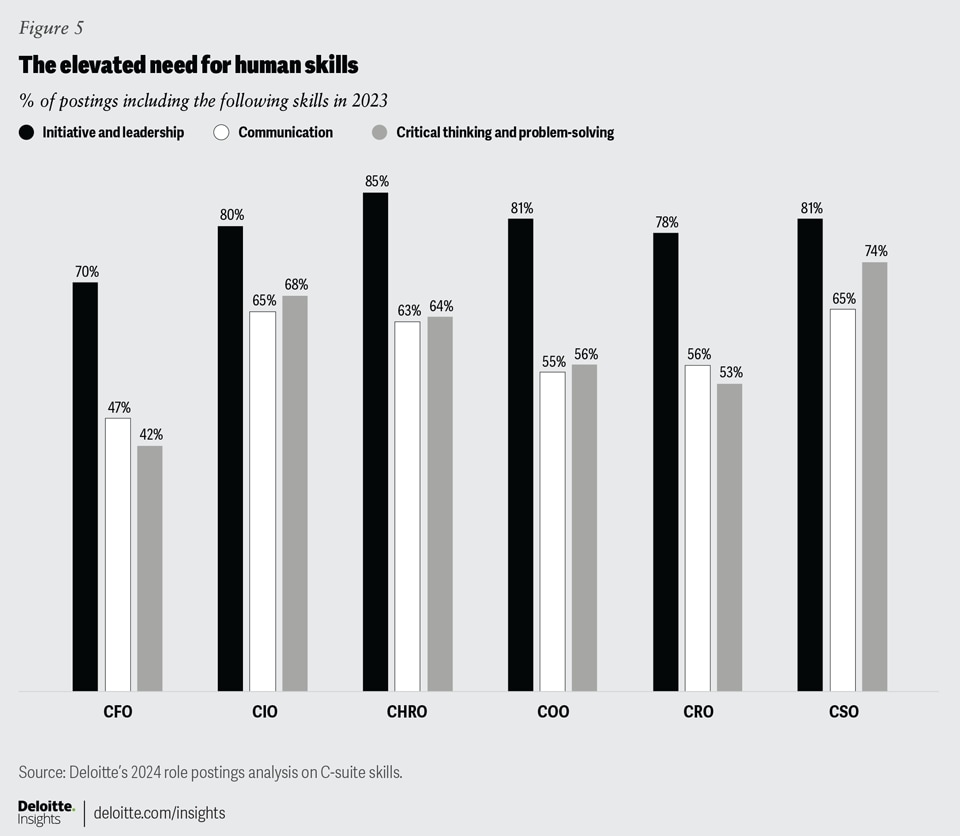
Source: Deloitte, Designing for growth in the C-suite
2020 onward: The leader through disruption
The COVID pandemic moved HR to the center of the business almost overnight.
Remote work, employee safety and workforce continuity became critical operating decisions, with HR leaders translating public policy into workplace practice while helping managers lead dispersed teams.
The Australian HR Institute reported a view that the pandemic moved HR 10 to 15 years forward. Leadership, change management and strategic workforce planning were identified as leading skills the profession needed to develop.[6]
The change went beyond hybrid work, with HR needing to balance employee expectations for flexibility with legal obligations and the practical needs of the organization.[7]
HR’s function was no longer supporting transformation from the side; instead, it became part of the mechanism through which change was understood and adopted.
2026: The designer of work
HR leaders are now deciding how people and AI should work together, which capabilities the business should build and where technology should take over transactional work.
SHRM describes modern HR leaders as employee experience engineers, change agents, and increasingly analytical decision makers. Better workforce data allows HR to move from retrospective reporting towards predictive workforce planning.[8]
Gartner’s 2026 research, based on 426 CHROs across 23 industries and four global regions, identifies four priorities:
- An HR focused AI strategy
- Workforce planning for a human and machine era
- Leadership readiness for continuous change
- Culture embedded in daily work.[9]
Deloitte reaches a similar conclusion. Modern CHROs need stronger quantitative capability and a deep understanding of the business, while remaining responsible for engagement and the organization’s culture.[1]

Source: Deloitte, Evolving CHRO competencies
This is not technology replacing the human side of HR. It is technology changing the decisions HR must make about people, skills, and work itself.
The modern HR role is a stack, not a swap

Source: Deloitte, Expanding the C-suite
HR can only offer advice to the CEO, which is as good as the quality of the data and information they have on hand. If they are still waiting for delayed or outdated employee data to be reconciled across spreadsheets, they may not be able to correctly guide Management in the best employee model for future skills.
The quality of the HR leader’s advice is directly tied to the quality and timeliness of the workforce information underneath it. Strategy becomes slower when operational data cannot be trusted across the business.
Prosci describes HR’s role in change as assessing readiness, communicating what will change, preparing people through training, and tracking whether adoption is taking place.[10] Those responsibilities require dependable information and enough capacity to act on it.
Technology alone will not turn HR into a strategic function, and a new platform cannot supply business judgment or earn executive trust. But fragmented systems can pull HR back towards administration, because every decision begins with finding, checking, and reconciling the data.
The evolution of the HR leader therefore raises a direct question for every organization:
Is your HR function equipped for the role the business now expects it to play, or is it still operating through systems designed for the personnel office?
Footnotes
[1] Deloitte, Reimagining CHRO roles and responsibilities for strategic growth
[2] Visier, The 100 Year History of the Human Resources Department
[3] Australian HR Institute, A brief history of HR
[4] Visier, HR as rule enforcers
[5] Australian HR Institute, The rise of strategic HR
[6] Australian HR Institute, HR in the 2020s and beyond
[7] European Institute of Leadership and Management, The Changing Role of HR in a Post Pandemic World
[8] SHRM, The Evolving Landscape of HR
[9] Gartner, 2026 HR Trends and CHRO Priorities
[10] Prosci, Change Management for Human Resources Professionals